Verified identities
A reviewer checks a passport before anyone can carry for you. Not an automated scan — a person.
Human review
Millions of people fly every day with room to spare in their luggage. BagFellow puts your parcel in that space — for a fraction of courier prices.

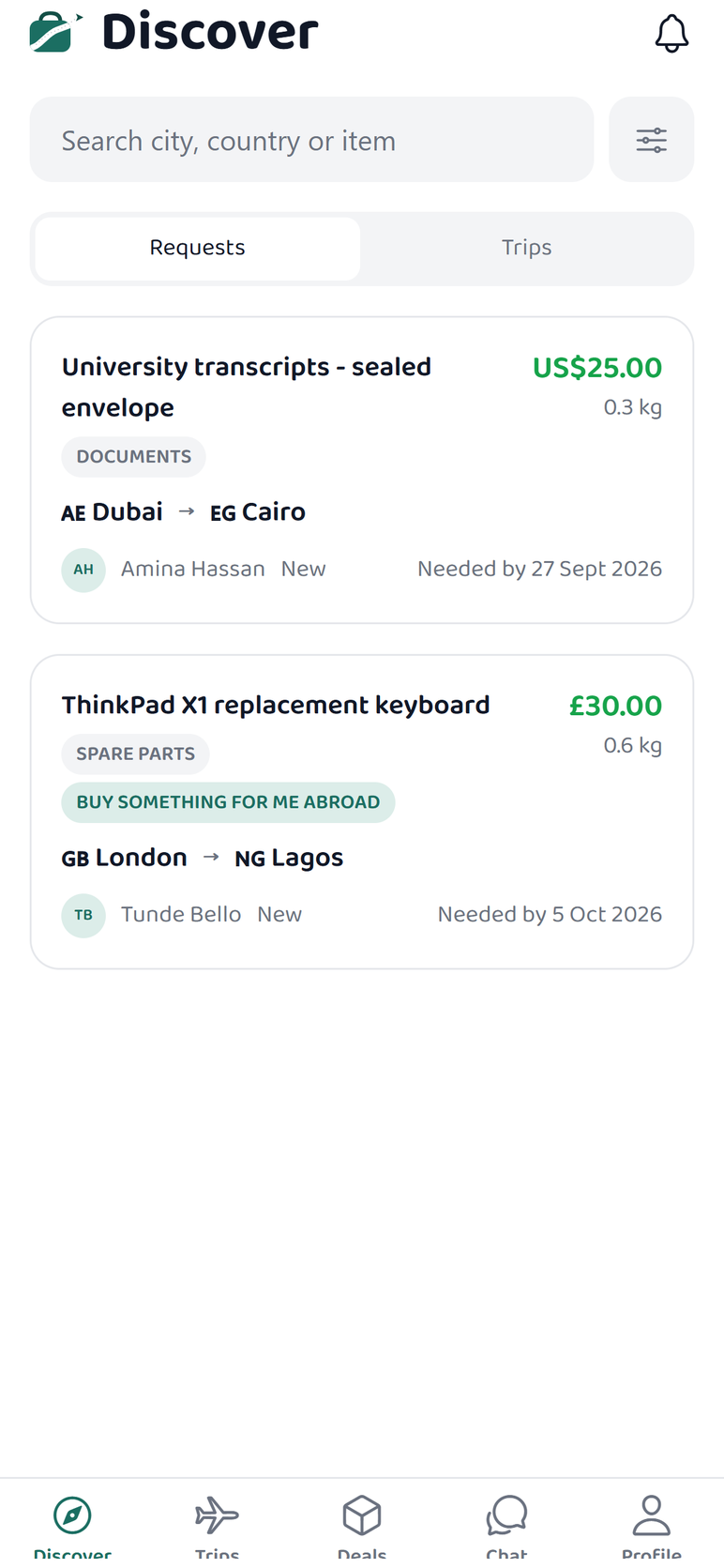
Real trips from real travellers. Filter to your route, then send a request — you will be asked to create an account before you do.
Loading trips…
The money never moves on a promise. It moves when the two of you meet and a code is scanned.
Search by where it is coming from and where it needs to go. Every traveller shows their spare weight and what they charge per item, so there is no haggling and no arithmetic.
Your payment is reserved with our payment provider — BagFellow never holds it.
You hand over in person and scan each other's QR code. That scan is the proof the delivery happened, and only then is the traveller paid.
A reviewer checks a passport before anyone can carry for you. Not an automated scan — a person.
Human reviewYour payment is reserved with our payment provider — BagFellow never holds it. The traveller can see it is reserved, but nobody can touch it until you confirm the handover.
You scan their code in person when your parcel arrives. That scan is the proof, and only then is anyone paid.
Every price and every balance is in dollars, so a rate move between agreeing and delivering cannot change what was agreed. Travellers are paid out in their own currency.
You are taking the flight anyway. Publish what you will carry and what you charge, and pick the requests that suit you.
You are never asked to carry anything you have not agreed to, and you see exactly what is inside before you accept.
Four steps, and you stay in control of every one of them.
Per item, in your own words — not a rate per kilo that nobody can picture.
Per item, not per kiloOnly goods on a set list of permitted items can be carried. You can see what is inside the parcel before you accept the request, so there are no surprises at customs.
Everyday goods onlyBefore you take it, you scan the shopper’s code and photograph the item as it is. That photograph is your record of what you received and what condition it was in — it is what protects you if anything is questioned later.
Your photo is your recordThe shopper’s payment is already reserved before you fly. Scanning the code at delivery is what sends it to you.
Scan = paidCommission falls from 10% to 5% as you climb the tiers. Payouts become available three days after delivery is confirmed, on every tier.
Example On a $40 reward you keep $36 at 10% → $38 at 5%
Most deliveries are uneventful. The platform is designed around the ones that are not.
Every payment sits in escrow against a double-entry ledger. It is released on proof of handover, never on somebody's say-so.
Travellers submit their booking reference and our team confirms the flight against the airline before the badge appears. Identity documents are reviewed the same way.
The shopper's code and the traveller's code are separate, and neither party can see the one they are meant to scan. Presence has to be real.
If something goes wrong, a reviewer sees both sides and the evidence and settles it — in your favour, theirs, or split. You always get the reasoning in writing.
Two sides, two sets of worries. Both are answered here rather than in a help centre nobody opens before signing up.
You post what you need sent and where it has to get to. Travellers already flying that route make offers. You pick one and pay, and your money is held until the delivery is confirmed — the traveller is not paid before that.
You carry that risk, and we do not insure it.
If the delivery does not happen, you get back everything you paid us — the reward and our fee.
Beyond that, the most we will recover for you is the value you declared, less anything already refunded to you, and only where we find that the traveller’s own negligence or deliberate act caused the loss or the damage. Declare the real value: it is the ceiling on what you can get back.
This is the honest version of what a stranger carrying your bag can promise. If you are sending something you could not stand to lose, do not send it.
The traveller should claim from the airline, because only they hold the ticket and the right to do so. Whatever the airline pays for your item belongs to you, and keeping it is treated as a deliberate act. An airline mishandling a bag is not by itself the traveller’s fault, so unless something else went wrong the value of the item falls to you.
You get back what you paid us — the reward and our fee — once the airline declares the bag lost. Until then the delivery is still open: a bag that turns up late is still a delivery.
A flight moving is not a cancellation. The delivery still happens, just later — and if the new date does not work for you, you can cancel and be refunded in full.
If the traveller cancels before collecting your item, your money stays where it is and your request goes back on the market. Nothing is paid to anyone until the delivery is confirmed. If they have already collected it, message us.
At the border the traveller is the declarant, so the duty is theirs. That is why they see exactly what they are carrying before they accept it, and can refuse anything, for any reason, before they collect it from you.
It also means what you send matters to someone other than you. Several of the same item is what turns personal baggage into an import, and some things must not be sent at all — the prohibited items list is short and it is binding. However, If we find that the traveller was not carrying a commercial quantity, and the duty was charged on your item specifically, then the duty is yours.
It does two things. It sets the minimum reward, so declaring more costs more to send; and it caps what can be recovered from a traveller found at fault, whether through negligence or a deliberate act. Understating it lowers both.
It depends on what you carry and what it’s worth, not only its weight. Everyday items start at $8 a kilo; electronics and valuables at $25 an item, rising with the item’s value. You keep 90% at first, rising to 95% as you complete more deliveries.
Delivering the item as you received it, on time. The sender carries the risk of ordinary loss. You are answerable only where we find that you caused it, in these cases:
Customs duty on what you carry is yours, unless we find that you were not carrying a commercial quantity and the duty was charged on one sender’s item specifically.
Yes — you are the one who answers for what is in your bag. So you may inspect any item, or refuse it outright, before accepting it. We record everything you accept. And some things must not be carried at all, whatever the reward.
Your payment is held from the moment the sender pays, and it is yours once the handover codes are scanned. It is paid out three days after the delivery, which is also the window a sender has to raise a problem. The three days are the same on every tier.
Straight to your bank account or mobile wallet, in your account’s local currency wherever we can send it. There is a minimum balance before you can withdraw, and your payout settings show it. Any transfer fee is deducted from the total, and we show you the full net amount before the withdrawal completes.
Yes — once. We review it ourselves, then it is stored encrypted, and no other member ever sees it. We do not use face recognition.
Warning: nobody at BagFellow will ever ask for your passport by email or any outside message. It is only ever uploaded inside the app.
Travellers keep 90% — and more as you climb.
Commission is charged on the reward, not on the value of the goods: a $300 laptop carried for a $40 reward is charged commission on the $40. The sender’s service fee is 5% of the reward and is the same on every tier; the traveller’s commission falls with tier, from 10% to 5%. If the fees together come to less than the platform minimum, the difference is added.
People have always sent things with travellers going the same way. Now the money is held until it is delivered, and every handover is scanned.